UGC (User Generated Content) refers to any content created by your users or customers — reviews, testimonials, social posts, videos, photos. It's one of the most credible and cost-effective marketing assets you can build, because it comes from real people, not the brand itself.
In this guide: what UGC actually is, the different formats it takes, real-world examples, and how to build a UGC strategy that generates trust and drives conversion.
UGC Content, Defined (User Generated Content)
UGC, or User Generated Content, is any content created directly by users rather than by the brand itself. It comes from your customers, your fans, your employees, or even influencers who speak up and produce content around your product, your service, or your world.
Think broadly here: it can come from a satisfied customer leaving a review on your site, an employee sharing a day in the office on their story, an influencer recommending your brand, or a fan posting a spontaneous video featuring your product. Every one of these counts.
The main types of UGC content:
Customers: through testimonials, reviews, real-life usage photos.
Employees: embodying company culture in an authentic way.
Influencers: when they feature your products in personal content (even outside sponsored campaigns).
Fans: through spontaneous, often highly creative content.
On the format side, UGC shows up everywhere:
Customer reviews: written reviews on ecommerce sites, ratings on Google, Trustpilot...
Photos: Instagram posts, Pinterest, community galleries on a website
Comments: on your social channels, your articles, your ads
Social posts: Facebook shares, LinkedIn posts, Reels, Stories...
Bottom line: the moment a user takes the initiative to create content about your brand, you're in UGC territory, and it's a powerful, living one.
UGC in Numbers: Key 2026 Stats
2026 data confirms UGC content is no longer optional: it's a full acquisition channel in its own right.
Performance and engagement
Instagram posts that include UGC content generate 70% more engagement than purely branded content
TikTok shows an average organic engagement rate of 2.63% per post for UGC content, the highest of any platform
User-generated content produces 6.9x more engagement on average than brand-created content
Conversion and revenue
Product pages that include UGC content convert 74% better than those without it
Social posts with UGC generated 10.38x more conversions than posts without it in Q3 2025
Adding UGC across every marketing touchpoint increases revenue per visitor by +154%
Consumer trust
92% of consumers trust peer recommendations more than direct brand messaging
84% of consumers trust brands more when they use UGC in their communication
60% of consumers see UGC as the most authentic form of marketing
Market and growth
The global UGC platform market is valued at $9.85 billion in 2026, on track for $35.44 billion by 2030
The number of professional UGC creators grew by +93% in a single year
Nearly 9 out of 10 companies now build UGC into their marketing strategy
Why UGC Content Works
UGC content has become a channel brands can't ignore. It reads as more authentic, more engaging, and more effective than traditional brand communication.
UGC Strength
Business Impact
Concrete Result
Authenticity
Builds trust
Users trust reviews and customer content more than advertising
Conversion
Speeds up decision-making
Sales lift driven by visible social proof (Eram, Airbnb, Sephora...)
Lower costs
Stretches the content budget
Less in-house production, better marketing ROI
SEO
Increases organic visibility
More indexable content, organic traffic, and backlinks
Community
Strengthens engagement
Customer advocates, long-term retention
The Most Effective UGC Formats Today
Not all UGC content is equal. Some formats drive far more impact than others, depending on the goal: awareness, engagement, or conversion.
UGC Format
Main Use
Business Impact
Customer reviews
Product pages, landing pages
Conversion: immediate social proof that reassures and triggers purchase
User photos
Website, Instagram, galleries
Awareness + conversion: authenticity and real-world product context
Short videos
TikTok, Reels, YouTube Shorts
Engagement + virality: strong organic reach and fast attention capture
Comments & testimonials
Blog, key pages, social channels
SEO + trust: enriches content and boosts credibility
Social posts
Posts, stories, hashtags, contests
Community engagement: viral effect and participation dynamics
Bottom line: the right mix of UGC content, matched to your channels and goals, gets the most out of your overall strategy.
How to Build UGC Into a Marketing Strategy (B2B & B2C)
Using user-generated content well isn't something you improvise. For a UGC strategy to work, it needs to be planned, structured, and aligned with your marketing goals.
1. Set clear objectives
Before anything else, get clear on what you want UGC to achieve for you.
Awareness: getting your brand in front of a wide audience.
Engagement: building regular interaction with your community.
Conversion: driving sales or leads.
Each goal shapes which formats and channels make sense.
2. Activate your community the smart way
To get user-generated content, you need to give people a reason to create it. A few techniques that work:
UGC contests: photo, video, or customer review submissions to win a prize.
Webinars and experience-sharing: inviting customers to share their expertise.
Specialized reviews: encouraging reviews on professional platforms (e.g., G2, Capterra).
B2B or B2C, the key is the same: put people at the center of your communication.
[rta-block=folder-cta][rta-title=h3]Want to explore your growth potential?[rta-title=h3][rta-btn=regular href="/prendre-rendez-vous-typeform" target=_blank]Get a free audit[rta-btn=regular][rta-block=folder-cta]
UGC Content by Platform: Examples and Best Practices for 2026
TikTok: the UGC playground
TikTok is the platform that has reshaped UGC content the most. Raw, unpolished formats outperform slick productions here. The 2026 trends working for brands:
#LearnOnTikTok: brands creating educational value through customers or employees (e.g., Carrefour and its in-store staff, who racked up millions of views with authentic content)
TikTok Shop + UGC: direct product tagging with one-click purchase; videos with native product tags convert 2x better
Live UGC: customers testing products live, in real time
Notable French example: Carrefour. A cashier (@leonie_carrefour) created raw content on the brand's TikTok account and went viral within days, generating organic reach money can't buy.
Instagram: UGC as social proof
On Instagram, UGC mostly works as social proof: photos of customers wearing an item, testing a product, visiting a place. The formats that work:
Customer posts reposted to stories (tagged and with permission)
Authentic UGC Reels (under 30 seconds, natural voice)
Before/after carousels with real testimonials
Golden rule for Instagram in 2026: always ask permission before reposting a user's content, and credit the original creator.
YouTube and long-form video
Long-form UGC video (reviews, detailed unboxings, comparisons) remains the format with the biggest impact on high-ticket purchase decisions. 74% of buyers watch UGC videos before a purchase over €100.
French brands that do UGC well
Back Market systematically embeds customer video testimonials on its product pages. Result: a conversion rate 40% higher on pages with UGC versus pages without it.
Patagonia builds its sustainability credibility through UGC content showing customers using its products in the real world (hiking, climbing). Authenticity guaranteed, zero greenwashing.
Sézane has built a community of customers who spontaneously post their outfits, a steady stream of UGC the brand reuses in its campaigns with the creators' consent.
How to Build UGC Content Into Your Marketing Strategy
Step
Goal
Key Actions
1. Generate it naturally
Create organic UGC
A standout product experience, "Instagrammable" packaging, a surprise element (gift, personalized note)
2. Encourage creation
Increase volume
Branded hashtag, contests, ambassador program, post-purchase reviews with a nudge to share
UGC is powerful, but it can also go wrong. You need to:
Moderate content that's inappropriate or off-brand.
Respond quickly to negative comments or potential crises.
Use moderation automation tools to save time without losing quality.
UGC Creator: the New Job in Digital Marketing
The big shift of 2025-2026: the rise of professional UGC creators. They aren't influencers in the classic sense; they don't necessarily have a large following. Their value is in creating authentic, unscripted videos that look like real customer testimonials, which brands then use in their paid ads and on product pages.
Why brands turn to UGC creators
The economics are hard to beat. A UGC video from a creator costs between €100 and €500. A traditional production of the same format costs 10 to 50 times more. And the UGC video often performs better because it looks authentic.
The UGC creator formats performing best in 2026:
The "day in my life" with natural product placement
Raw unboxing, no heavy editing
Before/after with a sincere voiceover
The "you need to know about this product" (direct recommendation)
The 30-second express tutorial (TikTok / Reels)
UGC creator vs. influencer: the difference
UGC Creator
Influencer
Audience
Not required
Essential
Value added
Authentic content
Distribution
Brand budget
€100-500/video
€500-50,000/post
Use case
Paid ads, product pages
Native posts
Goal
Conversion
Awareness
In France, the UGC creator market is still far from saturated: an opening for brands that build this channel into their acquisition strategy early.
✅ Quick checklist for a winning UGC strategy
[ ] Define your goals (awareness, engagement, conversion)
UGC content is no longer optional: it has become an accelerator of trust, engagement, and growth for brands that know how to use it well.
Whether you're in B2B or B2C, the challenge is simple: give your users a voice, showcase their stories, and build communication that's more human, more credible, and more effective.
Start small: find the UGC content you already have, encourage your customers to speak up, launch a first hashtag... and let the momentum build.
Sometimes, your community writes your best campaign for you.
What is UGC (User Generated Content) and why is it a strong trend in digital marketing?
UGC, or User Generated Content, refers to any content produced by a user, a customer, an internet user or a content creator, rather than by the brand itself. This trend responds to the need for more authentic, credible and engaging communication. In 2025, integrating UGC into a content strategy lets you reach a broader audience, promote your offerings in a more human way, and generate measurable performance in visibility, awareness and conversion.
What are the benefits of UGC for a brand or company?
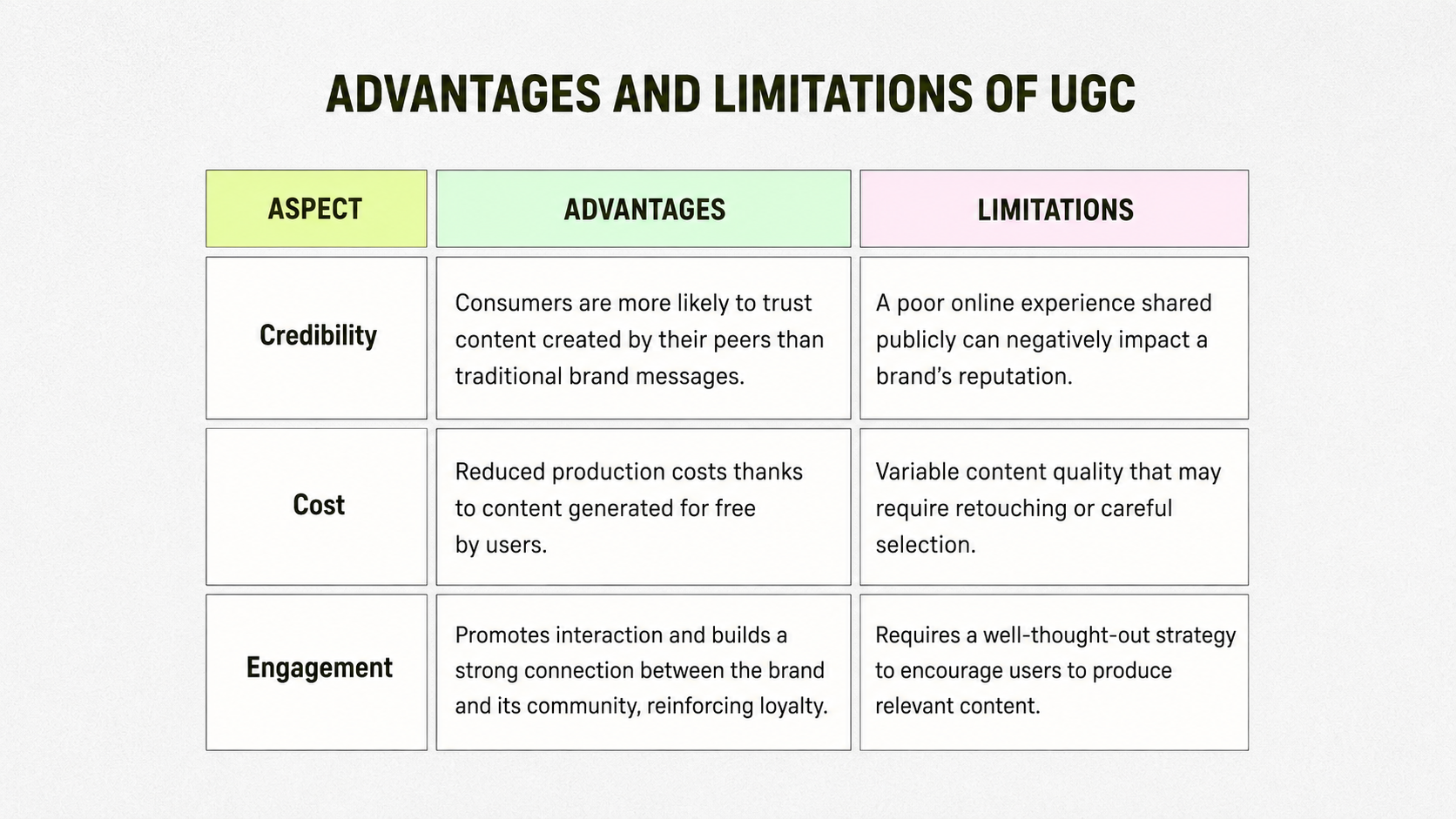
The main advantages of integrating UGC into your strategy are numerous. First, it strengthens a brand's credibility thanks to the social proof provided by content created by users. It also helps boost SEO, since authentic, varied content improves visibility on search engines. UGC also lets you increase a brand's presence on social media while reducing the costs associated with content creation. Finally, it fosters community engagement and strengthens loyalty among the target audience. Overall, UGC offers real added value to any brand strategy, provided it is integrated and moderated with care.
What types of UGC content can you include in a marketing campaign?
There are several forms of user-generated content. UGC videos, whether reviews, unboxings or tutorials, hold an important place thanks to their visual impact and authenticity. Product photos taken by customers also provide concrete proof of the product's real-world use. To this are added online comments and reviews, social media posts, as well as posts published in forums or on blogs, which enrich a brand's ecosystem. Each type of content has its own specifics and serves a different marketing goal, whether strengthening awareness, improving conversion or reassuring future customers.
How do you integrate UGC into your marketing strategy without legal issues?
In France, the use of content produced by a user must comply with several legal rules. It is essential to obtain authorization to publish and to take into account the copyright associated with the shared content. The use must also comply with the terms of service of the social platforms, and full transparency is required when it comes to paid partnerships. It is also important to put clear moderation in place, particularly to handle sensitive or inappropriate content. To simplify these steps, some platforms specialized in UGC, such as Bazaarvoice or Moggo, offer solutions that make it easier to manage these obligations.
How do you measure the impact of a UGC campaign on your marketing performance?
The success of a UGC campaign can be assessed from several key indicators. The engagement rate - including likes, comments and shares - is often the first signal of performance. Next come the conversions generated, whether sales, leads or sign-ups. Organic visibility, measured through traffic, backlinks or online presence, also offers a valuable reading of the content's impact. Time spent on pages featuring UGC is another significant indicator, as is the number of users who create or interact with this content. To analyze this data precisely, tools like Google Analytics, Sprout Social or Mention let you measure results effectively and assess the real impact of user contributions.
Which platforms or tools should you use to manage UGC content effectively?
There are now several UGC platforms suited to the needs of companies and agencies. TINT lets you collect, moderate and distribute social content generated by users. Moggo, a French platform, specializes in integrating UGC directly into e-commerce sites. Bazaarvoice particularly stands out for generating authentic customer reviews, while HubSpot offers the ability to integrate UGC within an overall marketing strategy, from emailing to automation. Together, these tools facilitate the entire process, from collecting content to moderating it, then integrating and distributing it digitally.
Why is UGC becoming a central element of marketing strategies in 2026?
UGC content is part of a broader evolution in digital marketing. Content creators now occupy a growing place, while audiences seek a more direct, more sincere relationship with brands. In this context, overly promotional campaigns are gradually losing effectiveness. UGC then emerges as a powerful alternative, capable of producing authentic, varied, low-cost content with strong emotional value. Integrating UGC into your strategy thus lets you fully meet today's expectations: more closeness, more creativity and, above all, more results.
Newsletter
Join those who are redefining AI-driven growth.
Get access to playbooks and feedback from those who are shaping the next wave of marketing and AI.
Thank you! Your submission has been received!
Oops! Something went wrong while submitting the form.


.jpeg)