You spend money on Google Ads every month but don't really know whether it's attracting new customers, increasing sales, or boosting brand awareness? That's normal: between automated formats, poorly targeted search network campaigns, fuzzy keywords, and landing pages that aren't always convincing, you can quickly burn money without seeing it happen.
A Google Ads audit is a chance to take back control of your online advertising strategy, understand how your ads are being served (search, shopping, display, YouTube, Gmail…), and most importantly identify what's holding back your performance. Whether you're in B2B, e-commerce, or a local SME that just wants more qualified traffic, this audit can truly change everything.
And you don't need to be an expert or touch a single line of code: today there are simple tools and methods to analyze your account, uncover useful insights, and finally maximize your ROI.
Why Audit Your Google Ads Campaigns?
Clicks are coming in, but sales aren't taking off? Your advertising budget is going into Google without you knowing what it's really bringing back in conversions or qualified traffic? That's often a sign it's time to put your Google Ads account on the table and run an audit — not just "tweak a few settings."
An effective Google Ads audit doesn't just skim your ads. It analyzes account structure, the logic of each campaign, keywords, targeting, and landing pages to identify what's generating value, what's limiting your visibility, and what's dragging down profitability. The goal: understand where your budget is going, and how to use it better in your digital marketing strategy.
When Google Ads Starts Going Off the Rails (and How to Spot It)
Some warning signs clearly indicate it's time to audit your Google Ads campaigns. If you recognize yourself in one or more of these situations, now is the right time to dig deeper:
Your CPCs are rising without a clear explanation: you're paying more per click, but your conversion rate or revenue isn't following. Your cost per acquisition is climbing, with no gain in profitability to show for it.
Your conversions are dropping or stagnating while you increase budget: your campaigns are consuming spend, traffic is arriving, but business results aren't moving.
Your impression share is low, despite a solid budget and a keyword strategy built for Google search: you're barely showing up in search results, and competitors are owning the space.
Your campaigns lack clarity: you no longer know what each campaign does, which ad groups are performing or not, or how your ads are actually being served.
You rely heavily on automated campaigns without understanding the rules: you let the platform decide, without knowing how bidding, targeting, or delivery are being managed.
You don't know which keywords and ads are profitable: it's hard to identify strengths, weaknesses, and real improvement opportunities.
In short: if your ad performance is unclear or disappointing, an audit isn't a luxury — it's a necessary step to regain control.
What You Really Gain with a Good Audit
A well-conducted Google Ads campaign audit isn't just another report sitting in a Drive folder. It's a direct lever for improving campaign profitability and clarifying your strategy.
Here's what you can expect from it:
A clear view of your numbers: you finally know which campaigns, keywords, and ads are generating conversions — and which are burning budget for nothing.
A lower cost per acquisition: by cutting underperforming segments and concentrating investment on what actually works, your advertising budget works harder, not necessarily more.
A cleaner, more readable account structure: every campaign has a role, every ad group has a logic, and your landing pages better match audience expectations.
Strong alignment between Google Ads and your business: campaigns are no longer there to "drive traffic," but to serve concrete objectives (contact request, quote request, sale, registration…).
Priority actions, step by step: a good audit delivers a structured diagnosis and a workable action plan, with optimizations you can start applying within days to improve your ad performance.
Auditing your account means transforming Google Ads from a fuzzy cost center into a tool at the service of your strategy.
Key Steps of a Structured Google Ads Audit
1. Back to Basics: Why Are You Advertising?
Before touching a single keyword, a good audit starts with a simple question: do your campaigns still match your real business objectives?
Targets and intent: are your ads still reaching the right profiles? Are the search intents being targeted clear?
Conversion cycle: are you talking to people ready to buy, or to curious visitors barely discovering your solution?
Featured offers: are the products or services pushed in ads still priorities in your sales strategy?
2. Is Your Account Well-Organized or a Mess?
The structure of your Google Ads account determines everything: performance readability, ease of optimization… and often, your profitability.
Campaign organization: each campaign should correspond to a precise objective, with no unnecessary overlaps.
Coherent ad groups: one theme per group, with perfectly aligned ads and keywords.
Relevant budget levels: are your budgets allocated based on the real profitability of each segment?
Clear hierarchy and naming logic: essential once you go beyond 5 to 6 campaigns.
A clean structure means easier management… and a solid foundation to scale.
3. Are Your Ads Reaching the Right People?
Showing a great ad to the wrong person is throwing money away. The audit must therefore dig into your delivery settings.
Geographic areas: are you visible where your audience actually is? Too many accounts target irrelevant countries or regions.
Time slots and devices: does performance vary between desktop and mobile? Between morning and evening?
Active audiences: are you using Google segments (intent, affinity, remarketing)? Are your audiences well-fed and up to date?
4. Keywords: Sort, Clean, Enrich
This is where the audit gets surgical. Keywords are the foundation of your campaigns — and also the primary source of waste.
Sort by performance: look at CTRs, CPCs, Quality Scores, and also cost per actual conversion.
Clean out useless queries: remove keywords that are too broad, redundant, or off-target.
Look for opportunities: are there relevant keywords you've never targeted?
Negative keywords: are they being used properly? Too vague? Nonexistent?
5. Ad Quality: Do Your Ads Actually Make People Want to Click?
Your copywriting can make all the difference. The audit evaluates whether your messages are clear, compelling, and consistent with the user's search intent.
Headlines and descriptions: do they hook from the first few seconds? Do they address the intent behind the keyword?
Calls to action: "Request a quote," "Try for free," "Book now"… are they suited to the context?
Extensions used: are sitelinks, callouts, and structured snippets properly integrated and up to date?
Ad rotation and A/B tests: Google doesn't test for you. Without variations, no optimization is possible.
One great ad can be enough to double your CTR. But first, you need to have tested it.
6. Landing Pages: Are Promises Kept After the Click?
Someone clicks… then what? This is where many campaigns fall apart.
Consistent message: does the visitor find the promise they saw in the ad?
Speed and usability: especially on mobile, every second counts.
Offer clarity: is the content clear, compelling, and focused on the expected action?
Bounce rate and conversions: are they consistent with the initial promise?
Optimizing your landing pages can generate +50% more conversions without touching your ad budget.
7. Tracking and Conversion Data
Without reliable data, intelligent optimization is impossible. And yet, this is the weakest link in many accounts.
Clean tagging: are your tags (Google Tag Manager, Consent Mode, GA4 events) properly installed?
Tracked conversions: are you measuring the right events? Not just button clicks?
Data consistency: between GA4, Google Ads, and your internal tools, do the numbers align?
ROAS-driven management: are your campaigns oriented toward real profitability… or toward low-quality volume?
Tools, Indicators, and Concrete Cases
The Right Tools to Audit Effectively
A solid Google Ads audit relies on the right tools. Here's the shortlist:
Google Ads Editor: to quickly audit your account structure and manage campaigns offline.
Seiso: perfect for spotting budget leaks, anomalies, or opportunities to dig into at a glance.
GA4: essential for connecting your campaigns to real on-site behavior (bounce rate, conversion funnel, etc.).
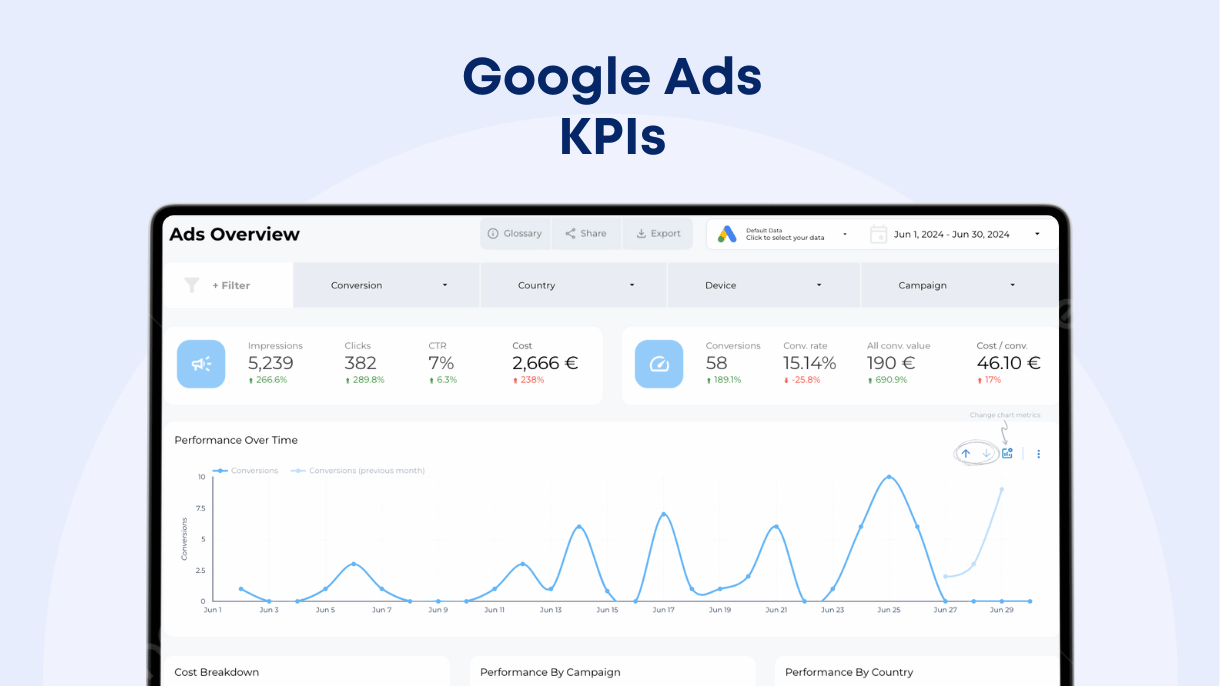
CPA & ROAS: the bottom line. Knowing what a conversion costs, and what it brings in.
Conversion rate & cost per useful session: concrete business indicators for managing the funnel, not just the ad.
This shifts you from click-based management to a real profitability logic.
Concrete Post-Audit Results
A well-conducted audit is often a turning point. Here's what we often observe after implementing recommendations:
–35% acquisition cost by cleaning out ineffective campaigns.
x2 on conversion rate thanks to better messaging and more effective pages.
20% budget recovered by cutting useless keywords and audiences.
These results don't come from a magic tool. Just from a serious reading of what your data is telling you.
[rta-block=folder-cta][rta-title=h3]Want to learn more about your paid potential?[rta-title=h3][rta-btn=regular href="/prendre-rendez-vous-typeform" target=_blank]Get a free audit[rta-btn=regular][rta-block=folder-cta]
Classic Blunders Found in 80% of Accounts
Even in well-funded accounts, certain mistakes keep coming back. And they drag down results without anyone noticing.
Classic traps
Targeting too broad: broadcasting everywhere, all the time, across the entire search network and sometimes the display network, drives up cost per click without guaranteeing more sales. Result: lots of clicks, little business.
No negative keywords: without exclusions, your keywords trigger on off-topic queries in Google search. The user clicks, you pay, but the session leads nowhere on your website.
Poorly defined objectives: when all conversions are lumped together, it's impossible to read your conversion tracking, calculate a reliable cost per conversion, or analyze results campaign by campaign.
No ad variants tested: without A/B testing, it's hard to analyze metrics, optimize click-through rate, or improve your Quality Score and overall account quality level.
Landing pages that miss the mark: a slow, confusing landing page, or one that's misaligned with the ad's promise, drives away your audience — even if your Google campaigns are well-built.
Campaign audits and account audits exist precisely to identify weaknesses, fix these leaks, and spot real improvement opportunities. Not to judge, but to adjust and make every euro invested more useful.
An Audit Is Not a Simple Technical Check
A good Google Ads audit is not just about ticking boxes or generating an automated report. It's an in-depth analysis that must interpret data, evaluate performance, and propose concrete actions.
Real expert work means:
linking campaigns to your business objectives, analyzing results step by step, highlighting what's truly profitable and what isn't. A serious paid audit concludes with a complete diagnosis, strategic recommendations, and a personalized action plan to optimize your campaigns, reduce costs, and target continuous profitability improvement.
What to expect from an effective Google Ads audit: clearer decisions, better-structured campaigns, and a strategy that advances your digital marketing rather than simply consuming budget.
What Bulldozer Brings Extra (and Why It Changes Everything)
A good audit isn't a 20-page PDF nobody reads. At Bulldozer, it's a genuine inflection point: the moment where your advertising budget finally starts delivering a real return on investment. Not in 6 months. Starting now.
A Growth-Oriented Approach
We don't look at your Google Ads account the way a technician looks at a machine. We see it as a growth lever to activate.
We start with your business objectives, not account settings.
We connect the analysis to the complete funnel: campaigns, landing pages, CRM pipeline.
We look for the real bottleneck: is it targeting? The message? The page? The tracking?
And above all: we talk in euros, not clicks. You won't hear us celebrate a 7% CTR if nothing is selling behind it.
Multi-lever Expertise
A good SEA audit must account for everything gravitating around your campaigns.
You already have an SEO strategy in place? We make sure there's no cannibalization.
You're working on email or automation? We help you synchronize your efforts.
You have multiple personas? Multiple offers? We help you clarify your advertising strategy so every euro goes to the right place.
And above all, you leave with an immediately actionable plan, not a list of vague ideas.
A Human, Strategic, Committed Audit
Let's cut to the chase:
If your current provider is lulling you to sleep with click-through rates, we'll challenge it.
If your processes are inefficient, we'll tell you.
If your account has untapped potential, we'll show you how to go get it.
No pointless jargon
No analysis set in stone
No slide deck forgotten at the bottom of a Drive
What we offer: an audit that serves a purpose, conducted by humans, for humans.
A Google Ads audit isn't a luxury. It's often the best way to regain clarity, take back control… and ensure every euro invested truly serves your growth. If your campaigns are going in circles, now is probably the time to hit pause and take action.
An audit lets you know whether your ad campaign is profitable, well targeted, and correctly delivered on the right networks (search, display, YouTube, Gmail, Discover, etc.). It helps you improve your performance, whether in customer acquisition, awareness, or paid search, and to maximize qualified traffic to your website.
What is the difference between a free and a paid audit?
A free audit is often automatic and limited. A paid audit is carried out by an expert who analyzes your Google Ads platform (formerly AdWords), your ad placements, your formats (video, display, shopping), your ads, and your Quality Score. It gives you actionable insights tied to your business, your geographic location, and your marketing objectives.
Which elements are analyzed during an audit?
- Your business objectives and their alignment with the campaigns
- The keywords used (search, shopping) and their performance
- The structure of the campaigns and ad groups
- The ad formats delivered (video, discover, Gmail, etc.)
- The landing pages and their consistency with the ads
- The targeting settings: audience, geolocation, device
- The tracking (sign-up, purchase, click, conversion, etc.)
- The cost per click, the conversion rate, and the Quality Score
Which tools should you use to audit your account?
- Google Ads Editor to audit and edit campaigns
- Seiso, Opteo, or Google Ads Insights for automatic analysis
- Google Analytics 4 and Google Tag Manager for real-time tracking
- SEMrush / Ahrefs to monitor competitors and improve your organic search (SEO)
- The Google France help center to better understand the ad platform's rules
When should you run an audit?
- If you're launching a new business or a mobile app
- If your search rankings are stalling or your web traffic is declining
- If your ad campaigns are expensive without measurable returns
- After a change of target, sales platform, or ad format
- Ideally, every 3 to 6 months, or with every major campaign launch
Newsletter
Join those who are redefining AI-driven growth.
Get access to playbooks and feedback from those who are shaping the next wave of marketing and AI.
Thank you! Your submission has been received!
Oops! Something went wrong while submitting the form.

.jpeg)